Teaching an AI to Parse Emails Once, Then Never Again
May 19, 2026
In the United States, anyone planning to dig calls 811 first, and the local utilities get notified so nobody puts a backhoe through a gas line. Those notifications, called locate tickets, arrive as email. Every state system and every partner formats them differently: different labels, different field ordering, different delimiters, sometimes a full reformat with no warning.
The legacy answer at the utility infrastructure company where I work was a hand-maintained rules system. A new email format appears, a human studies it, a human writes extraction rules, the parser works until the format changes again. It is exactly as fun as it sounds, and the queue of unparsed formats never quite reaches zero.
The obvious architecture is the wrong one
The moment you say “unstructured email” and “extraction” in the same sentence, the obvious 2026 answer is: send every email to an LLM and ask for JSON.
I rejected that design before writing any code. Cost was the loudest reason: we see a handful of new formats a year and thousands of messages a day, so per-message inference pays thousands of times over for knowledge the system already has.
Latency and nondeterminism were close behind. An LLM round trip per message is a tax you pay forever, and locate tickets feed time-boxed regulatory workflows that cannot absorb it. The same email should parse the same way every time; a model that is 99.5% consistent is a slow-burning incident generator in a compliance workflow.
Then there’s the audit question. “Why did this ticket parse this way?” needs an answer that is a rule you can read, not a temperature setting.
What actually changes is the format, not the message. So put the intelligence where the change happens.
Parse with profiles, heal with one LLM call
The system I built works like this:
- Normalize. A pipeline of normalizers strips the volatile junk: encodings, wrapped lines, signature noise.
- Fingerprint. Compute a structural fingerprint of the normalized message: the skeleton of labels, ordering, and delimiters, with the variable content removed. Two messages in the same format produce the same signature even though every field value differs.
- Match. Look the signature up in the profile store. Known signature: apply the stored extraction profile, a purely static, declarative set of rules. This is the hot path, and it contains no AI at all.
- Heal. Unknown signature: make exactly one LLM call. The model’s job is not to parse the message. Its job is to write the extraction profile for this format: where each field lives, what pattern captures it, what the delimiters are. The profile is stored against the signature, and every future message in that format parses statically.
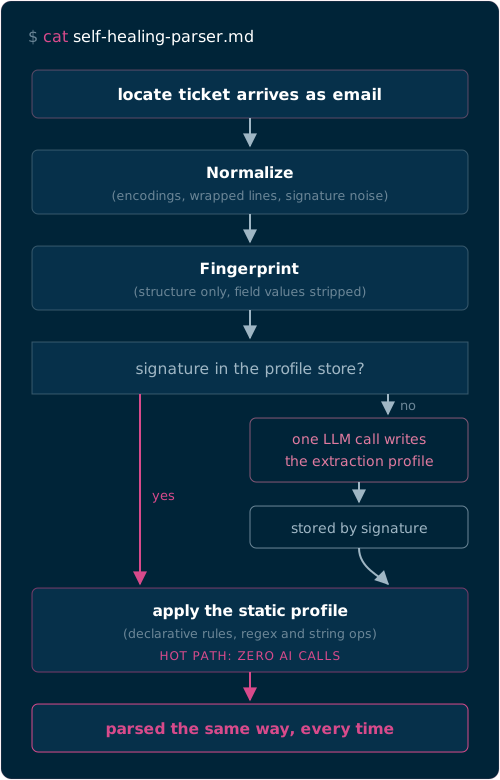
The comparison ends up lopsided:
| LLM per message | Profile generation | |
|---|---|---|
| Inference cost | O(messages) | O(formats) |
| Hot-path latency | Model round trip | Regex and string ops |
| Determinism | Best effort | Total |
| Audit trail | Prompt and prayer | A readable profile |
The part I did not expect
The first working version came together in one focused day at our monthly professional development day, working solo with AI coding tools. I bring that up for what it says about where the effort in this design actually lives.
Normalization and fingerprinting are the hard 20% that make the LLM’s job easy. When the model only has to describe a format once, with a clean normalized sample in front of it, you are asking it for the thing LLMs are genuinely great at: noticing structure and writing it down.
A self-healing system also fails better. If the model writes a bad profile, you find out on the first message of a new format, in one place, with a reviewable artifact to fix. A per-message design smears that same failure across thousands of messages as a subtle quality problem.
Where to put the LLM
Put the LLM where the change happens, not where the work happens. Inference at design time is cheap and cacheable, and it leaves behind an artifact you can review. Inference on the hot path is a per-transaction tax on cost, latency, and determinism. So when the variability in a problem is low-frequency (formats, schemas) and the volume is high-frequency (messages, requests), have the model generate the deterministic artifact once and let boring code run it forever.